






Consultation
Manufacturing
About Us

Guiding projects,
building trust,
finding solutions

AirTree (a unit of We4U Maintenance Pvt Ltd) is India's most trusted HVAC and Air Handling Unit manufacturer. Established in 2018 by industry veterans, we bring decades of expertise to every project.

Our Vision

To create an India where every industry breathes better with accessible, efficient HVAC solutions.

Our Mission

  • Deliver Quality That Lasts
  • Never Miss A Deadline
  • Innovate Responsibly
Why Choose Us

Trusted care,
lasting positive change

With a commitment to quality and reliability, we empower industries to achieve optimal air management. Our team of experienced engineers provides:

Experienced Professionals

Expert engineers with decades of HVAC experience.

Client-Centered Approach

Your project's success is our primary focus.

Safe & Reliable Systems

ISO-certified quality at every step.

Commitment To Growth

Constantly innovating for better solutions.

Consultation Session
• Contact Us • Contact Us • Contact Us •
Our Products

Advanced HVAC Solutions for Every Industry

From compact units to large-scale industrial systems, AirTree delivers customized solutions engineered for optimal performance.

Wet Scrubber (Fume Exhaust)
Pollution Control Equipment's
Dry Scrubber (Fume Exhaust)
Pollution Control Equipment's
Hybrid Air Washer
Air Ventilation & Cooling System
Double Stage Air Washer Unit
Air Ventilation & Cooling System
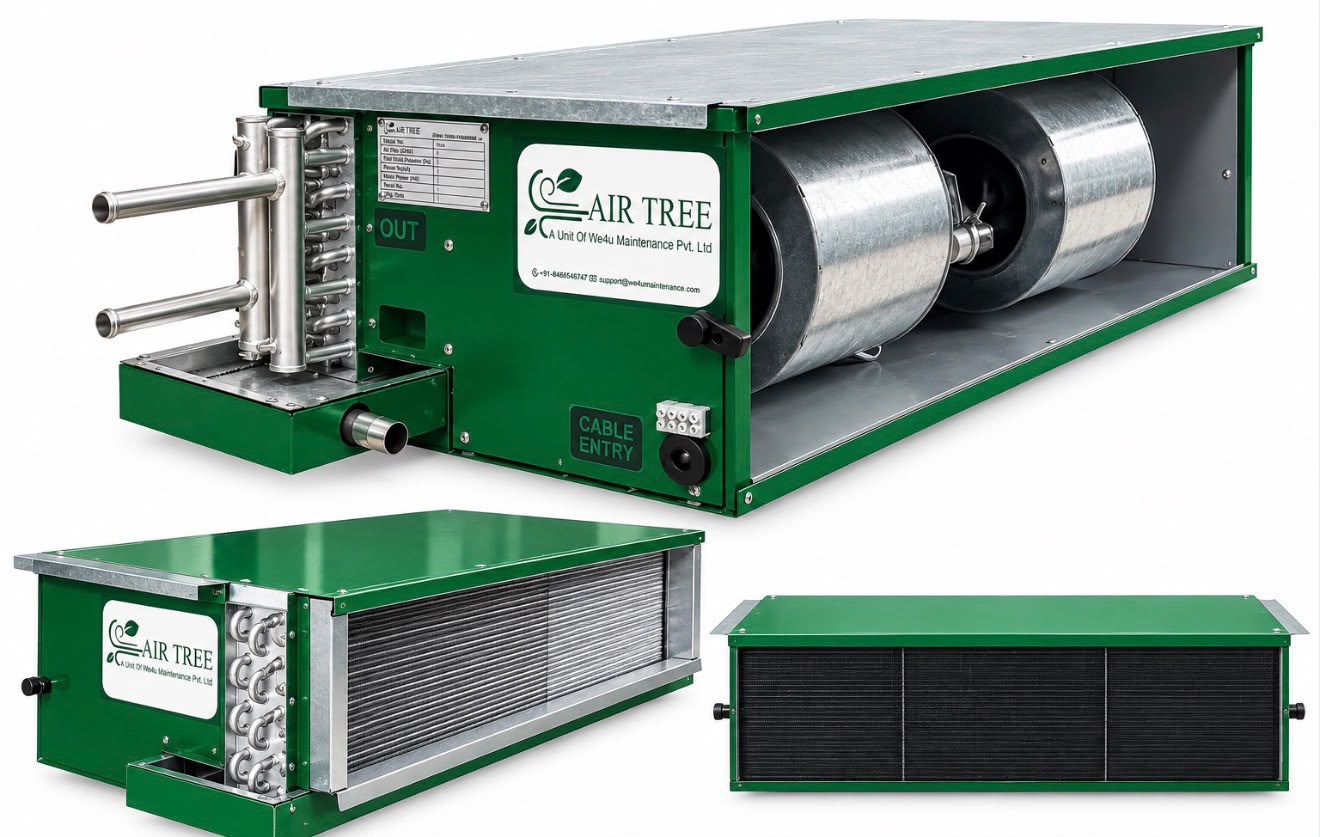
Double Skin Fresh Air Unit
Air Ventilation & Cooling System
Double Skin Air Washer
Air Ventilation & Cooling System
SISW Exhaust Fans
Air Ventilation & Cooling System
Industries We Serve

Where Every Industry Breathes Better

With years of experience across diverse sectors, we design systems that optimize air quality, temperature, and ventilation efficiency.

Industries & Units

Robust air management for manufacturing excellence.

Hotels & Restaurants

Supreme comfort and kitchen ventilation specialists.

Malls & Retail

High-volume AHUs for massive footfall spaces.

Offices & IT Parks

Energy efficient cooling for productive workspaces.

Hospitals & Labs

Sterile air solutions for healthcare critical zones.

Residential & Comm.

Custom HVAC design for premium buildings.

Utility & Gen. Rooms

Specialized ventilation for critical equipment zones.

Our Promise

Why Choose AirTree?

We don't just commit — we deliver. Experience the AirTree difference.

10 Days

Dispatch within 10 Days

HVAC equipment ready in just 10 Days. We understand project timelines and never miss deadlines.

100%

In-House Manufacturing

Zero dependency, total quality control. Every unit crafted in our state-of-the-art facility.

Expert

Commercial Kitchen Experts

Specialized systems designed for efficiency, hygiene & long life in professional kitchens.

Nationwide

Pan India Presence

Supplying projects across metros & emerging cities with equal speed and precision.

24/7

Service First Approach

From consultation to commissioning, we stay till it runs right. 24-48 hour response time.

Fast

Strategic Logistics

Advanced inventory management and dedicated dispatch team for seamless delivery.

97%
Client Satisfaction
500+
Projects Completed
100+
Cities Served
25+
Years Experience
Industry Insights

Latest from the AirTree Journal

View blogs
Oct 29, 2026

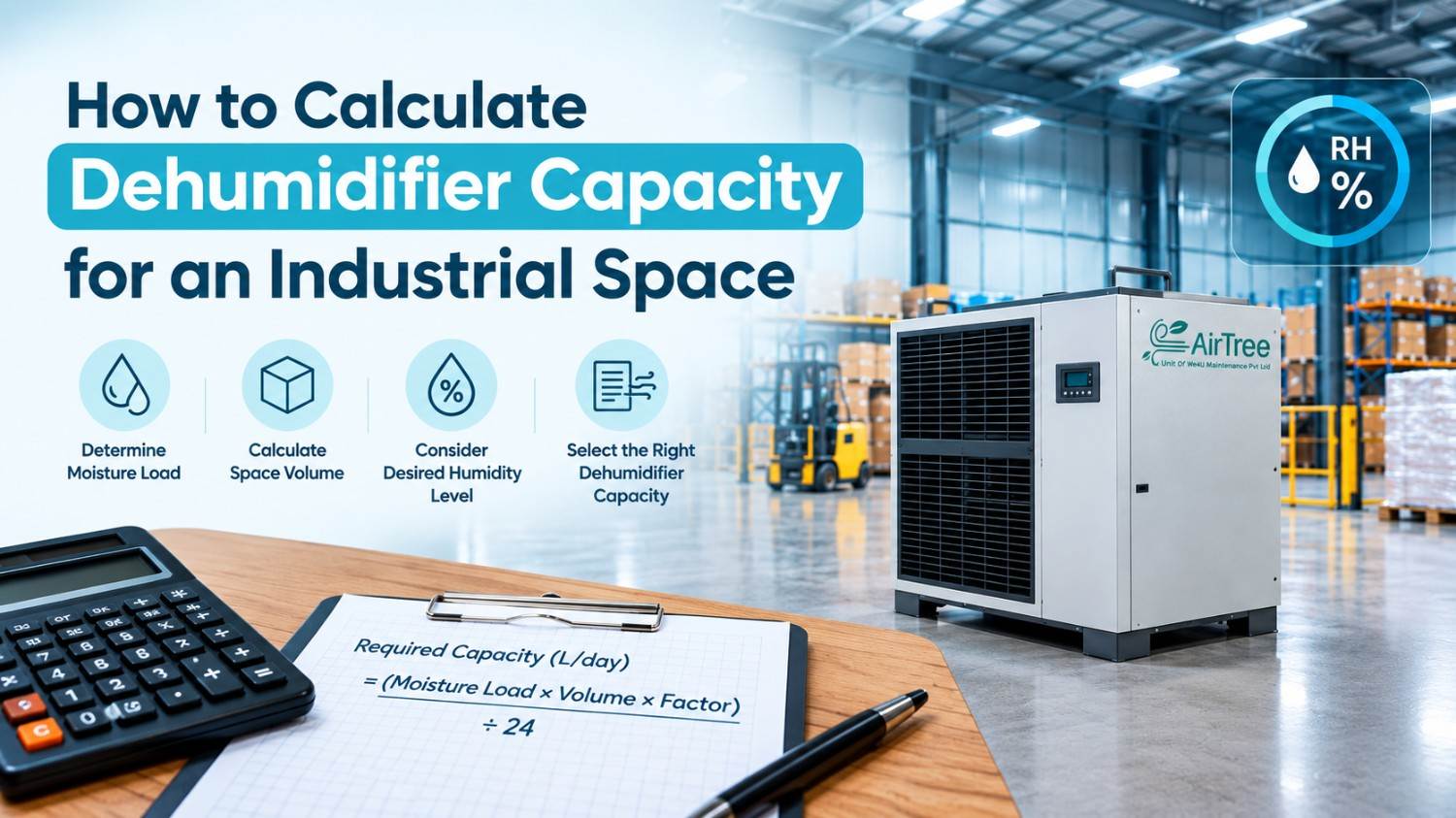
How to Calculate Dehumidifier Capacity for an Industrial Space

Quick answer: Dehumidifier capacity is the moisture entering your space every hour, plus a safety margin. Add up the water brought in by outside air, people and process work, then multiply by 1.15 to 1.25. Compare that figure, in kg of water per hour, with a unit's rating at your own room conditions.Excess humidity does real damage in industrial buildings. It rusts machined parts, cakes powders, puts condensation on packaging, grows mould on stored goods and causes static problems in electronics. In a pharma area it can push a batch out of specification. A dehumidifier only helps if it matches the load it actually faces.An undersized dehumidifier runs around the clock and never reaches its set point. An oversized one costs more to buy and, in some designs, cycles badly. Sizing it properly takes a tape measure, a psychrometric chart and about twenty minutes. This guide walks through the method, with a worked example for a plant in Delhi NCR.Step 1: Set the conditions you need to holdDecide the indoor temperature and relative humidity (RH) your product or process needs. Then find the worst outdoor condition at your site. In North India that is the monsoon, often 32 to 35 °C at 70 to 80% RH.SpaceTypical target RHPharma packing and coating30 to 50%Electronics assembly40 to 60%Food and packaging40 to 55%Metal and machinery storage40 to 50%Treat these as starting ranges. Your product specification or applicable standard always overrides them.Next, convert each condition into a humidity ratio, which is grams of water per kg of dry air. A psychrometric chart or any online calculator does this in seconds. The gap between outdoor and indoor values is the water every kilogram of incoming air carries into the room.Step 2: Add up the moisture loadFour sources matter.Outside air. This covers leakage through doors, gaps and openings, plus any fresh air you supply on purpose. It is usually the largest share. For leakage, a rough planning figure is 0.25 to 0.5 air changes per hour in a reasonably tight building, and 1 or more where loading doors open often.People. Allow about 0.05 to 0.15 kg/h per person, depending on how hard they work.Process. Open tanks, washing, steam, wet products and drying all add water. Get these numbers from your process team, because this is the load most often forgotten.Building ingress. Vapour passing through walls and roofs is small in insulated rooms. In an uninsulated shed it can be significant, so raise your margin there.The outside-air load uses this formula: Load (kg/h) = airflow (m³/h) × 1.2 × humidity ratio difference (g/kg) ÷ 1000Step 3: A worked exampleTake a packing hall measuring 20 m × 15 m × 5 m, which is 1,500 m³. The target is 24 °C and 50% RH, a humidity ratio of 9.3 g/kg. The monsoon outdoor condition is 32 °C and 70% RH, or 21.1 g/kg. The difference is 11.8 g/kg.SourceBasisLoad (kg/h)Air leakage0.5 air changes per hour, 750 m³/h10.6Fresh air600 m³/h supplied8.5People20 people at 0.1 kg/h2.0ProcessWashing area, from process team3.0Subtotal 24.1With 15% margin24.1 × 1.1527.7The hall needs roughly 28 kg of water removed per hour. Since 1 kg of water is about 1 litre, that is close to 670 litres per day. These figures are illustrative, so use your own airflow and process data.Step 4: Check the rating at your conditionsBrochure ratings are usually quoted at a warm, humid test point such as 30 °C and 80% RH. At 24 °C and 50% RH the same machine can remove well under half as much. Ask the manufacturer for output at your design condition, not the headline number.If fresh air is pre-treated in an air handling unit, the load on the room dehumidifier falls. Our guide on what an air handling unit is explains how a cooling coil and fan section handle that job.Step 5: Plan placement and controlsSizing is only half the job. Put the unit where it can draw from the dampest part of the room, and make sure its airflow reaches every corner so no dead zones form. Seal gaps and fit strip curtains or air curtains at loading bays to cut the leakage you just calculated. Mount the RH sensor away from the unit's outlet and from doors, so it reads the room and not a local draught. Condensate from a refrigerant unit needs a proper drain, and a desiccant unit's regeneration exhaust should be ducted outside.Refrigerant or desiccant: which type fits?Refrigerant (condensing). Cools air below its dew point so water condenses on a coil. It suits rooms above about 20 °C that need 45 to 60% RH, and it uses less energy per kg removed.Desiccant. Draws moisture into a rotating wheel, which is dried with heated air. It holds 20 to 40% RH and works in cold rooms where a coil would frost.The packing hall above, at 24 °C and 50% RH, normally suits a refrigerant unit. Had the target been 30% RH, a desiccant unit would be the safer choice.Sizing mistakes to avoidUsing average weather instead of the peak monsoon condition.Ignoring loading bays, shutters and doors that stay open.Leaving process moisture out of the total.Trusting the nameplate figure instead of output at room conditions.Skipping RH sensors and controls, so the unit cannot hold the set point.Frequently asked questionsHow do I calculate dehumidifier capacity for a factory? Find the humidity ratio difference between outdoor and indoor air, multiply it by the air entering per hour, and add people and process moisture. Apply a 15 to 25% margin. The result is in kg/h.How many litres per day is 1 kg/h? About 24 litres per day, because 1 kg of water is roughly 1 litre. Our example load of 28 kg/h works out to around 670 litres per day.Is a bigger dehumidifier always better? No. Oversizing raises purchase and running cost and can make some units cycle on and off. A 15 to 25% margin over the calculated load is usually enough.Can I size a dehumidifier from floor area alone? No. Floor area gives only a rough idea. The load comes from air leakage, people and process moisture, so two rooms of the same size can need very different capacities.Which type should I use for 30% RH? Use a desiccant dehumidifier. Refrigerant units struggle to hold humidity that low, especially in cooler rooms.Get your space sizedIf you would rather have an engineer check the numbers, send your room dimensions, target RH and process details to AirTree HVAC. You can see the full dehumidifier and air handling range on our products page, and find more HVAC guides on the AirTree blog.
Oct 26, 2026

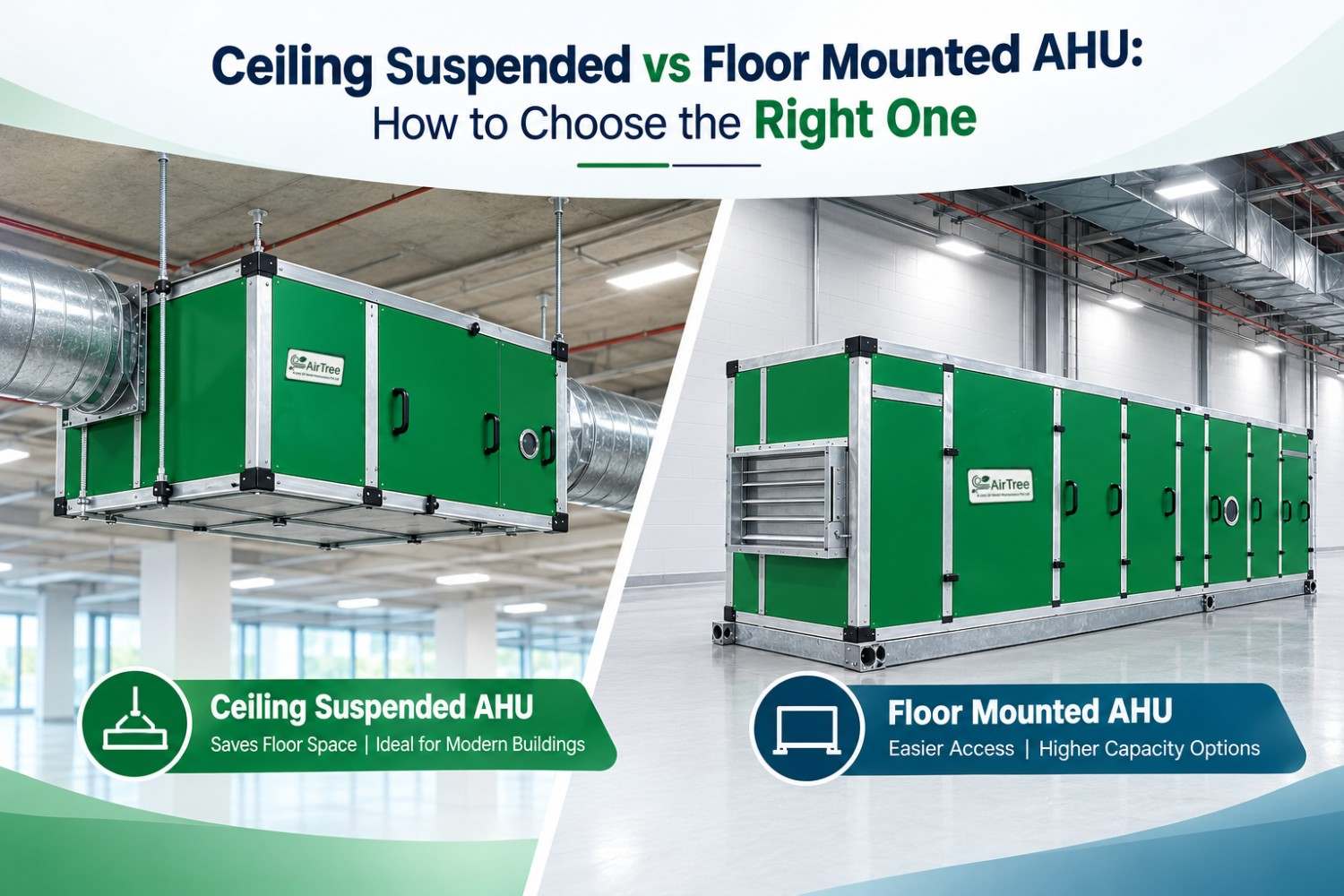
Ceiling Suspended vs Floor Mounted AHU: How to Choose the Right One

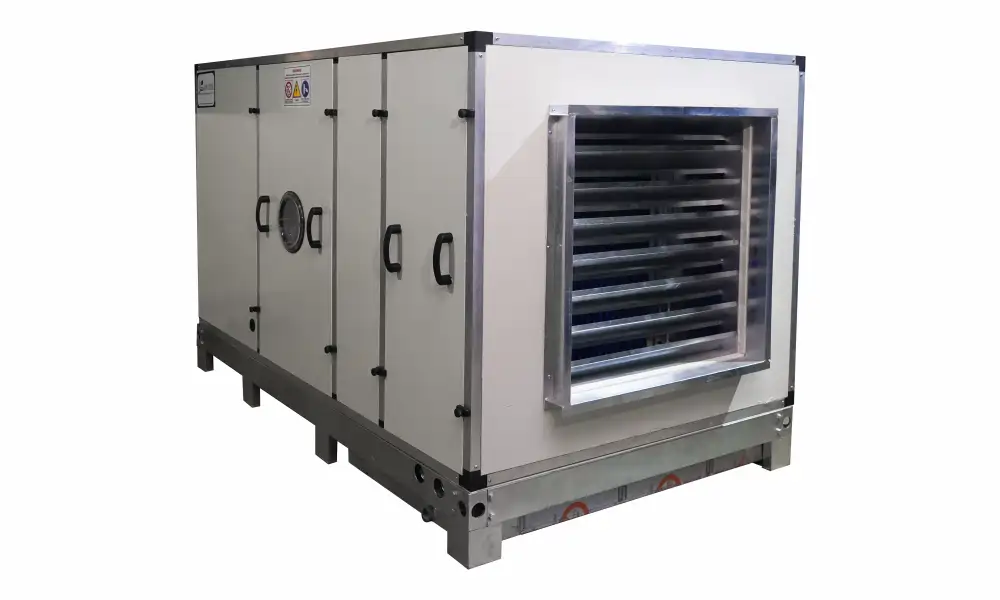
A ceiling suspended AHU hangs from the slab above the false ceiling, so it suits buildings with little plant room space. A floor mounted AHU stands on a plinth in a plant room and suits large airflows and heavy-duty use. Choose by space, airflow, filtration and servicing access.Most AHU quotations begin with a capacity figure, but the first real decision is simpler: where will the unit sit? Put it in the wrong place and you pay for it every year, in noise complaints, awkward filter changes and ducting that runs further than it should.This guide compares the two layouts we are asked about most, the ceiling suspended AHU and the floor mounted AHU, and gives you a short set of questions to settle the choice for your own building.What Each Type IsAn air handling unit does the same job in both layouts. A fan moves air through filters and a cooling coil, sometimes a heating coil or humidity section, and sends it into ducts. What changes is the housing and how it is supported.A ceiling suspended AHU is a compact unit hung from the slab on rods or brackets, usually inside the false ceiling void. A floor mounted AHU is a larger modular unit that sits on a base frame or plinth, normally in a dedicated plant room, and can be built from several sections joined in a row.When a Ceiling Suspended AHU Makes SenseThe main reason to choose a suspended unit is space. If the building has no spare plant room, or the plant room was given to something else during design, hanging the AHU above the ceiling frees that floor area for rent or use.It fits well in offices, hotels, malls, hospitals and other commercial buildings where each floor or zone has its own unit. Airtree's Ceiling Suspended AHU covers 700 to 12,000 CFM, can be supplied with or without treated fresh air, and can include double-skin panels and access doors for maintenance.The trade-offs are real, though. Capacity tops out lower than a floor mounted unit, the structure above must carry the weight, and servicing happens overhead. Filter and coil access needs a proper service panel in the ceiling and enough clearance to work.When a Floor Mounted AHU Makes SenseA floor mounted unit is the workhorse for large airflows and demanding air quality. Because it stands on the ground, it can be longer, taller and heavier, with room for extra sections such as multi-stage filters, a heat recovery section, a humidity section and large coils.That is why it shows up in pharma plants, hospitals, laboratories, airports and clean rooms. Airtree's Floor Mounted AHU is built for high air volumes and critical applications, and can be configured for return air, fresh air or treated fresh air.The cost is floor area. You need a plant room, a plinth, clear space around the unit for coil pull-out and filter access, and a duct route into the building. In return, servicing is easier, because technicians work at floor level with the unit's full length in front of them.Ceiling Suspended vs Floor Mounted AHU: Side by SideFactorCeiling suspendedFloor mountedInstallationHung from the slab, above the false ceilingOn a plinth in a plant roomFloor areaNone usedNeeds a plant roomAir volumeSmall to mid-size (Airtree: 700 to 12,000 CFM)Mid-size to very largeSections and filtrationPossible, but limited by unit sizeMore sections, more room for fine filter stagesServicingOverhead, through access panelsAt floor level, full accessNoiseClose to occupied rooms, needs careKept away in the plant roomTypical useOffices, hotels, malls, floor-wise zonesHospitals, pharma, labs, airports, clean roomsSix Questions That Settle the ChoiceHow much air do you need? Work out the airflow for the zone first. Small and mid-size zones suit a suspended unit. Very large halls or whole-wing duties lean toward floor mounted.Do you have a plant room? If you do not, and cannot create one, the decision is already made.How strict is the air quality brief? Clean rooms, operation theatres and pharma areas need several filter stages and tight humidity control, which is easier to build into a longer floor mounted unit.Can the ceiling carry it? A suspended unit puts its full weight on the slab. Ask your structural engineer to confirm the hangers and load before you order.How loud can it be? A unit above a meeting room or hotel corridor sits close to people. Check the noise data and use vibration isolators. A plant room keeps that sound away from occupants.Who will service it, and how? Count the units. Twenty suspended AHUs mean twenty overhead service points, while two floor mounted units mean two. Plan the access panels now.Many buildings use both: floor mounted units in the plant room for large halls and critical zones, suspended units on upper floors where space is tight. A treated fresh air unit can then handle ventilation for either, which matters when you design to ASHRAE 62.1 rates.Common Mistakes to AvoidSizing by tonnage per square foot alone, instead of a proper load calculation.Choosing a suspended unit and forgetting the service clearance around it.Ignoring noise when the unit sits above an occupied room.Placing filters and coils where nobody can reach them, so they never get cleaned. Our guide on cleaning an AHU cooling coil shows what regular access saves you.Treating fresh air as an afterthought. For wider system choices, see our guide to choosing the right HVAC system.Where Airtree Fits InAirtree makes both layouts in Greater Noida, along with Vertical AHUs, Cooling coils and treated fresh air units, so one team can specify the whole air path. If you are unsure which suits your project, share your layout, airflow and air quality needs and the engineers will recommend a configuration.Browse the air handling unit range, see the full products catalogue, or get a quote. If you are weighing AHUs against room-level units, our comparison of AHU vs FCU explains the difference.Frequently Asked QuestionsWhat is the main difference between a ceiling suspended and a floor mounted AHU? A ceiling suspended AHU hangs above the false ceiling and saves floor space. A floor mounted AHU stands in a plant room and handles larger airflows and more sections.Which AHU is better for hospitals? Both are used. Critical zones with strict filtration and humidity control usually get floor mounted units, while lighter-duty areas can use ceiling suspended ones.What airflow does a ceiling suspended AHU cover? Airtree's Ceiling Suspended AHU covers 700 to 12,000 CFM, with or without treated fresh air.Does a ceiling suspended AHU need a plant room? No. It goes above the false ceiling, but it needs structural support, service access and a drain route for condensate.Can one building use both types? Yes. Many buildings pair floor mounted units for large or critical zones with suspended units where space is limited.Keep reading: browse the Airtree blog or the Knowledge Hub for more on air handling and ventilation.

Oct 19, 2026

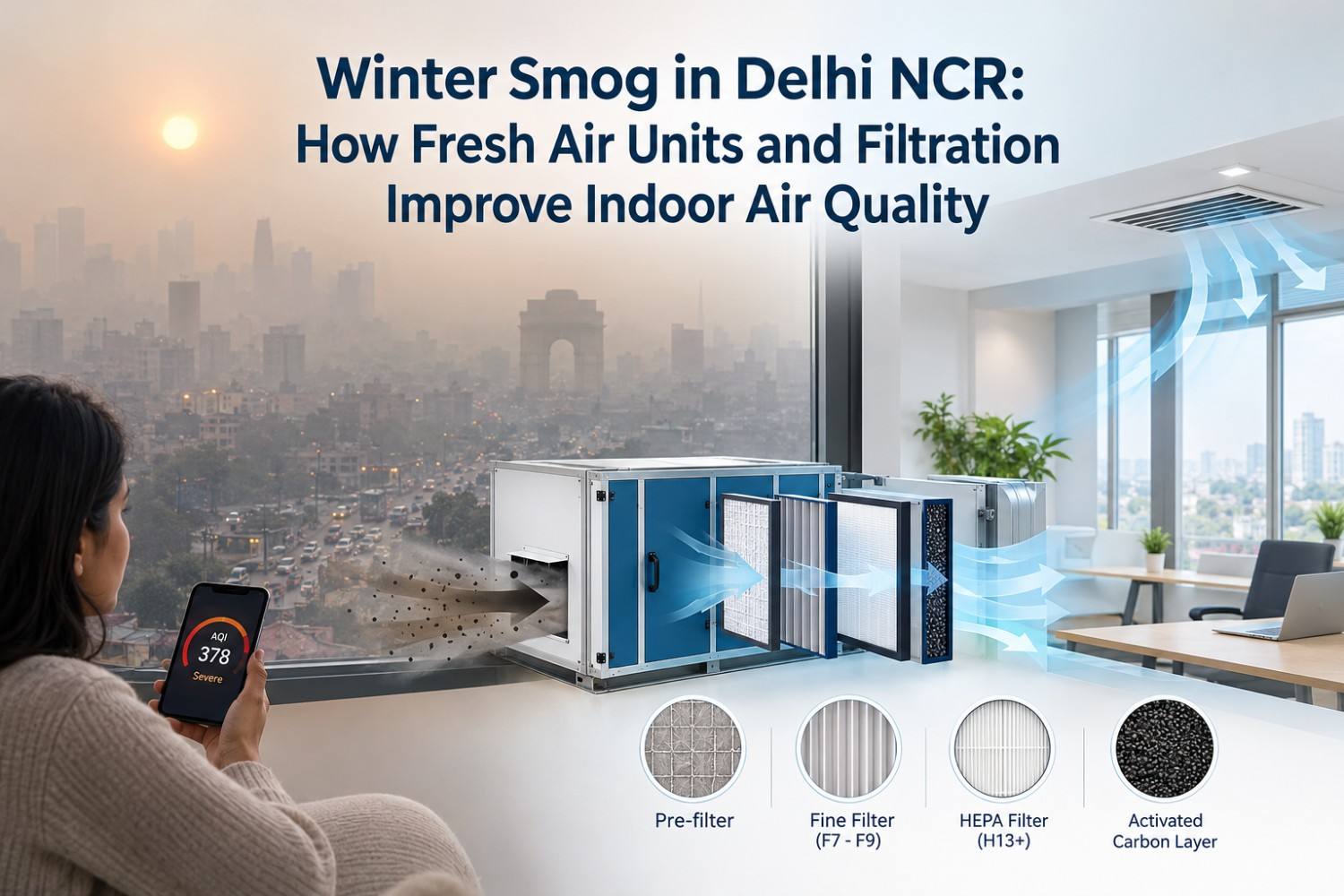
Winter Smog in Delhi NCR: How Fresh Air Units and Filtration Improve Indoor Air Quality

A fresh air unit is a ventilation system that draws outdoor air through filters, treats it and supplies it to a building at a controlled rate while stale air is exhausted. In smog season, it keeps PM2.5 out and CO2 down without opening windows.Around the last week of October, Delhi NCR changes. The sun looks pale by late afternoon, the air smells faintly of smoke, and the AQI app becomes the first thing people check in the morning. Most offices and households respond the same way: shut the windows, switch on a purifier, and wait for the wind to turn.That helps, but it is only half a plan. A sealed room with no fresh air brings its own problems, from stuffy meeting rooms to heavy-headed afternoons. This guide explains why winter smog in Delhi NCR gets indoors, what actually cleans the air you breathe, and how fresh air units and filtration work together.Why Delhi NCR Smog Peaks in WinterThe region does not suddenly produce more pollution in November. The weather just stops clearing it. Cold nights and weak winds create a temperature inversion, a layer of warm air sitting over cooler air near the ground, which works like a lid. Vehicle exhaust, construction dust, industrial emissions, waste burning and smoke from crop residue fires in neighbouring states all collect underneath it.The pollutant to watch is PM2.5: particles under 2.5 microns, roughly thirty times thinner than a human hair. They slip past the nose and throat and settle deep in the lungs. India's national standard allows a 24-hour average of 60 µg/m³ for PM2.5, while the World Health Organization recommends a much stricter 15 µg/m³. On bad days, NCR readings run well past both.Why Your Indoor Air Is Not as Clean as You ThinkIt is easy to assume indoor air is safer. During smog season that is only partly true. Outdoor air leaks in through door frames, window tracks, balcony sliders and the gaps around AC sleeves and pipe cut-outs. Indoor PM2.5 usually follows the outdoor reading with a delay of a few hours.Then there is what we add ourselves: cooking fumes, incense, cleaning sprays, dust from carpets and the carbon dioxide every person breathes out. In a closed office or bedroom, CO2 builds up quickly. Many ventilation guidelines treat a sustained level above roughly 1,000 ppm as a sign of under-ventilation. People feel it as a heavy head and poor focus, then blame the smog.So the goal has two parts: keep polluted air out, and keep fresh air coming in.What a Fresh Air Unit DoesA fresh air unit draws outdoor air through filters, treats it and supplies it to the building at a controlled rate, while stale air leaves through a separate exhaust path. In larger buildings this job usually goes to a treated fresh air unit, which cools, heats, dehumidifies and filters 100% outside air before it reaches occupied rooms. Airtree's Treated Fresh Air Unit is built for exactly this.Three things change once one is running:Pollutants get diluted. Fresh, filtered air replaces air loaded with CO2, moisture, odours and cooking particles.The building stays slightly pressurised. When a little more air is supplied than leaves, air pushes outward through gaps instead of pulling unfiltered smog in.Windows stay shut. You get ventilation without inviting the smog inside.Many setups also add a heat recovery unit, which passes heat between outgoing and incoming air. That cuts the load on your cooling and heating.Filtration: The Part That Does the Real WorkA fresh air unit is only as good as the filters inside it. Good systems clean air in stages.Pre-filter. Catches coarse dust, hair, insects and pollen, and protects everything behind it.Fine filter (F7 to F9 class). Captures most PM10 and a useful share of PM2.5.HEPA filter (H13 or higher). Removes at least 99.95% of particles at the most penetrating size, which is why it is the usual benchmark for smog-grade cleaning.Activated carbon layer. Adsorbs smoke smell and some gases, including VOCs.Two practical points. First, filters clog faster in smog months, so follow the replacement schedule and inspect them more often between October and February. A clean cooling coil matters as well, and our guide on cleaning an AHU cooling coil without damaging the fins shows how.Second, a filter only works when air is forced through it. Poorly sealed housings let air slip around the media, so installation quality counts as much as the filter grade. The casing matters too. Double-skin panels, like those on Airtree's Double Skin Fresh Air Unit, add insulation and keep noise down.Fresh Air Unit vs Air Purifier: Which Do You Need?The two are often treated as rivals, but they solve different problems.A standalone air purifier recirculates and cleans the air already in the room. It is portable and good at removing particles. It cannot lower CO2 or bring in outside air.A fresh air unit ventilates the whole space and filters what enters. It is a fixed installation, but it fixes the stuffiness a closed-window winter creates.For most NCR buildings, a sensible plan is a fresh air unit for baseline ventilation and filtration, with portable purifiers as a boost in rooms that need it, such as a clinic waiting area or a nursery. If you are weighing larger systems, our comparison of AHU vs FCU explains where each one fits.A Smog-Season Checklist for Any BuildingThese habits help whether or not you have a system installed:Check the AQI before opening a window, and air the building out when readings dip, usually mid-afternoon.Seal gaps with weatherstripping and door sweeps.Run the kitchen exhaust while cooking and skip incense in closed rooms.Keep a CO2 and PM2.5 monitor where people spend long hours.Service filters before the season starts, not halfway through it.Where Airtree Fits InAirtree is an HVAC and ventilation manufacturer based in Greater Noida, supplying projects across Delhi, Noida, Gurugram, Ghaziabad and Faridabad. The range covers treated fresh air units, air handling units, heat recovery units and cooling coils, all made in-house.For offices, hospitals, malls, hotels and premium residential buildings, the team can study your floor plan, occupancy and fresh air requirement, then specify unit size and filter stages to match. Planning now, before the heaviest weeks in November, leaves time to size the system and schedule installation properly. You can browse the full products catalogue, look at the air ventilation and cooling systems, or get a quote.Frequently Asked QuestionsDoes winter smog affect indoor air quality?Yes. Outdoor PM2.5 enters through gaps in doors and windows, and indoor levels usually rise a few hours after outdoor levels do.Can a fresh air unit remove PM2.5? Yes, when it has fine and HEPA-grade filters. Incoming air passes through them before it reaches the rooms.Is a fresh air unit better than an air purifier?They do different jobs. Purifiers clean recirculated air. Fresh air units bring in filtered outdoor air and expel stale air, which also controls CO2. Many buildings use both.How often should filters be changed in Delhi NCR? It depends on the filter type and usage, but smog season shortens filter life. Follow the maker's schedule and inspect filters more often between October and February.Is it safe to keep windows closed all winter?Closed windows keep smog out, but without mechanical ventilation, CO2 and moisture build up. A fresh air unit solves that.Keep reading: browse the Airtree blog or the Knowledge Hub for more on ventilation and indoor air.

How We Work

Our Process. Your Solutions.

Built for precision, delivered for performance.

01

Understanding Your Need

Every site is unique — our experts study your space, airflow requirements, and challenges.

02

Design & Customization

We design optimized systems tailored to your application, energy usage, and space.

03

Precision Manufacturing

Every AirTree product is crafted in our state-of-the-art facility with automated quality checks.

04

Quick Dispatch

Our logistics network ensures your system is ready and delivered within 7 working days.

05

On-Site Support

From installation assistance to after-sales service, we're with you at every step.

Ready to Upgrade Your Air Quality?

Get a comprehensive HVAC audit and custom solution proposal for your facility within 24 hours.

Get In Touch

Let's Discuss Your Requirement

Have a project in mind? Reach out to us for expert consultation and technical support.

Headquarters

Site-5 J 63/4, Kasna Road, Industrial Area,
Block D, Surajpur Site V, Greater Noida, UP - 201312

Working Hours

Monday - Saturday: 9:30 AM - 6:00 PM
Sunday: Closed

Send us a message

Download Our Brochure

Fill in your details to get instant access to our product catalog

+91